Mark J Davey Art
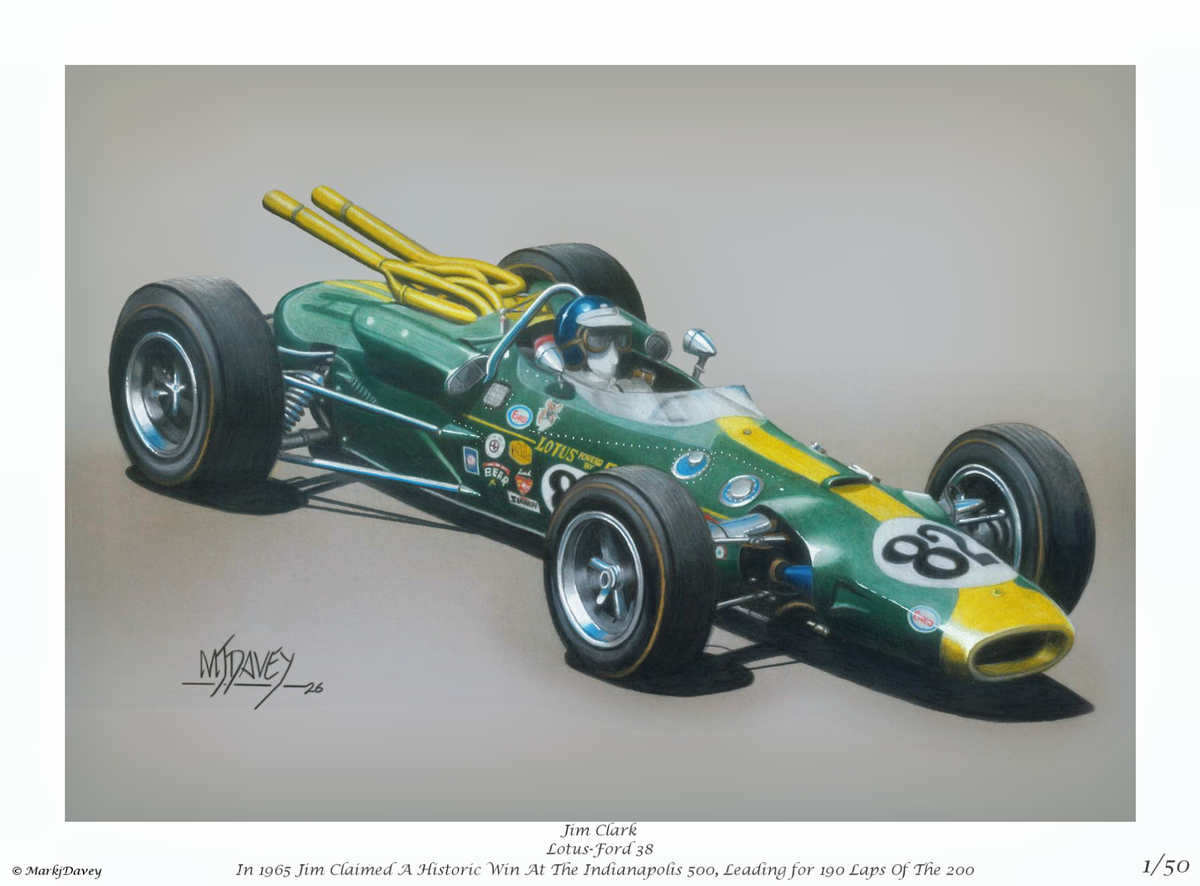
Lotus-Ford 38 Indy 500 With Jim Clark at The Wheel - Numbered Limited Edition Giclee print With COA
Lotus-Ford 38 Indy 500 With Jim Clark at The Wheel - Numbered Limited Edition Giclee print With COA
Couldn't load pickup availability
Jim Clark won the 1965 Indianapolis 500 in the Lotus 38 (chassis 38/1, car #82), the first rear-engined car to take victory at the Brickyard. He led 190 of the 200 laps and averaged a record 150.686 mph—the first time the race was run over 150 mph.
The Lotus 38 was an evolution of the earlier Lotus 29 and 34 Indy cars. Designed primarily by Len Terry (under Colin Chapman’s direction), it featured a full aluminum monocoque chassis (unlike the semi-monocoque predecessors), an offset layout suited to left-turn ovals, and a mid-mounted Ford 4.2-liter (256 ci) DOHC V8 making roughly 500 hp. Power went through a ZF 2-speed transaxle. It weighed about 1,349 lb (612 kg) and was finished in British Racing Green with yellow accents.
Clark (Team Lotus) qualified second at 160.729 mph (with a one-lap record of 160.973 mph). A.J. Foyt took pole at 161.233 mph in a Lotus-Ford. From the start, Clark seized the lead, briefly lost it to Foyt on lap 2, retook it on lap 3, and then stayed in front except during his two rapid pit stops (handled by the Wood Brothers NASCAR crew, who could refuel ~50 gallons in under 20 seconds). Foyt led a total of about 10 laps before transmission failure on lap 115. Clark crossed the line nearly two minutes ahead of second-place Parnelli Jones (also in a Lotus-Ford), with Mario Andretti third. Teammate Bobby Johns finished seventh in the other works Lotus 38.
This was Clark’s third Indy attempt. He finished second in 1963 (Lotus 29) and led from pole in 1964 (Lotus 34) before retiring with tire trouble. The 1965 win capped the rear-engine revolution at Indianapolis (27 of 33 starters were already mid-engined), ended the front-engine Offenhauser roadster era as a dominant force, delivered Ford’s first Indy 500 victory, and marked the first win by a British chassis and the first by a foreign driver since 1916. The winning car is preserved in the Henry Ford Museum collection.

The Lotus 38’s success (and design ideas) influenced later Indy cars and even fed into Lotus Formula 1 thinking.